
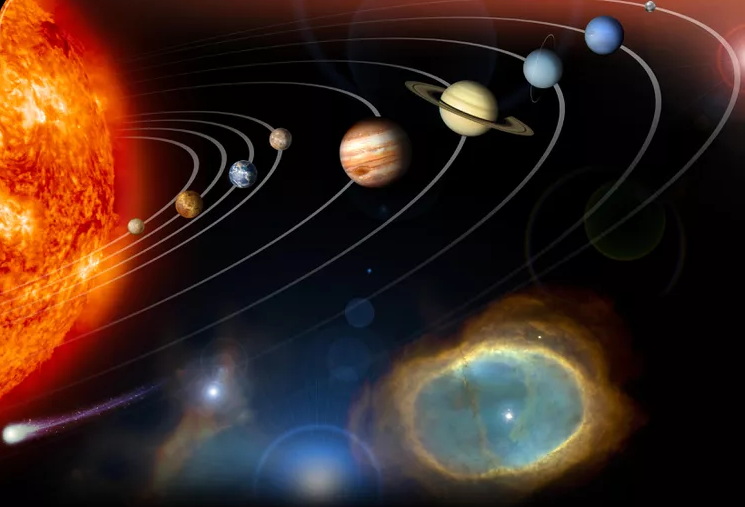
Galaxy mode is where Consuming Void opens up into something truly special. Unlike Campaign’s hand-crafted levels, Galaxy drops you into a procedurally generated universe filled with asteroids, planets, and stars — and it’s up to you to chart your own path through the cosmos. There’s no set endpoint. Just you, the void, and an infinite hunger.
How Galaxy Mode Works
When you start Galaxy mode, you spawn as a small black hole in a vast, procedurally generated space. The universe stretches out in every direction, filled with objects of wildly varying sizes. Asteroids float in loose clusters, planets orbit in predictable patterns, and distant stars pulse with the promise of enormous mass — if you can grow large enough to consume them.
Unlike Campaign, there’s no level structure. Galaxy mode is a continuous experience where the universe generates new content as you explore further from your spawn point. The further you travel, the larger and more rewarding the objects become, but the gaps between consumable objects also increase. It’s a risk-reward balance that defines every Galaxy run.
Your score in Galaxy mode is your final mass. The leaderboard tracks the biggest black holes, and reaching the upper tiers requires smart navigation, efficient consumption, and knowing when to push deeper into unexplored territory.
Early Game: Establishing Your Foundation
The area around your spawn point is always populated with small shapes and debris — the same kind of material you consumed in Campaign’s early levels. This starter zone is your nursery, and how quickly you clear it determines the trajectory of your entire run.
Don’t rush out of the starter zone. Clear it methodically, sweeping in expanding circles from your spawn point. Every small object matters when you’re tiny, and the density of objects near spawn is the highest you’ll encounter for a while. Players who bolt toward the first asteroid they see often find themselves stranded in empty space, too small to eat anything around them and too far from the starter debris to backtrack efficiently.
Once you’ve consumed everything in the immediate area, you’ll be large enough to start tackling small asteroids. This is your signal to pick a direction and commit. Galaxy mode’s universe is roughly uniform in distribution, so there’s no “best” direction. What matters is picking one and sticking with it.
Mid Game: The Asteroid Belt Strategy
The transition from consuming shapes to consuming asteroids is Galaxy mode’s first major milestone. Asteroids are scattered in loose belts and clusters throughout the universe, and finding dense clusters is the key to efficient mid-game growth.
When you encounter a cluster of asteroids, resist the urge to eat the biggest one first. Start with the smallest asteroids on the cluster’s edge and work inward. This spiral approach ensures you’re always consuming the most efficient target for your current size. Eating an asteroid that’s only slightly smaller than you gives less relative growth than eating five asteroids that are half your size.
Between clusters, you’ll cross stretches of relatively empty space. These transition zones are where impatient players lose runs. Don’t waste energy zigzagging after stray debris during crossings. Pick the most direct path to the next visible cluster and maintain course. The tiny mass you’d gain from chasing scattered shapes doesn’t compensate for the time lost.
One advanced technique for the mid game: use the camera to scout ahead. Your view naturally extends further as you grow, but you can also note the direction where objects appear denser on the edges of your screen. Train yourself to read the distribution pattern and steer toward density.
Late Game: Planetary Consumption
When your black hole is large enough to consume small planets, Galaxy mode enters its most rewarding phase. Planets give enormous mass boosts and are the primary way to push into the upper score brackets.
Planets in Galaxy mode come in several sizes. The smallest are rocky bodies not much bigger than large asteroids. Mid-size planets are gas-giant-like objects that require significant mass to consume. The largest planets are near-star-size bodies that represent huge milestones.
The key to planetary consumption is approaching from the right angle. Planets have gravitational influence in Galaxy mode — they’ll pull nearby objects (including small asteroids and debris) toward them. Use this to your advantage. Approach a planet’s gravitational field, let it draw nearby consumable objects toward you, eat those first for a small boost, then consume the planet itself. It’s a technique that experienced players call “feeding off the gravity well.”
Don’t attempt to consume a planet that’s barely within your range. If you misjudge and it’s too large, you’ll bounce off it and potentially get pushed into empty space. Wait until you’re confident — a planet should look noticeably smaller than your black hole before you commit to consuming it.
Advanced Navigation Techniques
The Spiral Path. Instead of traveling in a straight line outward from spawn, move in a gradually expanding spiral. This covers more unique territory per unit distance and increases your chances of encountering dense clusters. You’ll also naturally circle back near previously cleared areas, catching any objects you missed.
Landmark Memory. As you explore, take mental note of large objects you can’t yet consume — particularly stars or massive planets. These serve as landmarks and future targets. When you’ve grown enough, navigate back to consume them. The mass boost from a star can be run-defining.
Edge Scanning. The edges of your visible area constantly reveal new terrain. Get into the habit of checking all four edges of your screen regularly. If you see a dense cluster forming at the edge, adjust your path to intercept it. Opportunities appear and disappear as you move — stay alert.
Speed vs. Precision. In Galaxy mode, there’s a constant tension between moving fast to cover territory and moving slowly to consume everything. Early and mid game, favor precision — you need every bit of mass. Late game, when small objects barely register, favor speed and focus only on planets and stars.
Star Consumption: The End Game
Stars are the ultimate prize in Galaxy mode. They’re rare, they’re massive, and consuming one catapults your score into elite territory. But reaching star-consuming size requires a near-perfect run up to that point.
Stars appear further from spawn and are visually distinct — they glow and pulse, making them visible from considerable distance. When you spot your first star, it becomes your long-term target. Don’t beeline for it immediately. Continue your growth pattern, consuming everything on the path toward it, and only attempt consumption when your black hole dwarfs the star.
Successfully consuming a star is one of the most satisfying moments in Consuming Void. Your black hole’s growth animation is dramatic, your score jumps enormously, and the gravitational effects ripple through nearby objects. After your first star, the universe feels small — and that’s the point.
Common Galaxy Mode Mistakes
Overcommitting to empty space. If you’ve been traveling in one direction and objects are getting sparse, consider changing course rather than pushing further into the void. Dead space kills runs.
Ignoring small objects late game. While individual shapes barely matter when you’re large, dense clusters of small objects still add up. Don’t fly over resources just because they seem insignificant.
Playing too cautiously. Galaxy mode rewards calculated aggression. Once you’re confident in your size relative to a target, consume it immediately. Hesitation costs time, and time in Galaxy mode means other objects drifting further away.
Neglecting the return trip. If you traveled far from spawn to consume a planet, the area between you and spawn is now empty. Plan your post-planet route to pass through new territory, not backtrack through space you’ve already cleared.
Score Optimization
For competitive players aiming at top scores, Galaxy mode success comes down to three factors: growth rate per minute, route efficiency, and knowing your consumption thresholds. Track your personal benchmarks. How large are you at the two-minute mark? The five-minute mark? Consistent early-game performance gives you a reliable platform for the variable mid and late game.
The procedural generation means every run is different, but the principles remain constant. Adapt your route to whatever the universe gives you, maintain steady growth, and always be moving toward the next cluster.
Galaxy mode is Consuming Void at its most meditative and its most strategic. There’s no timer, no enemies, just the endless cosmos and your growing appetite. Master it, and you’ll understand why this mode keeps players coming back for hundreds of runs.